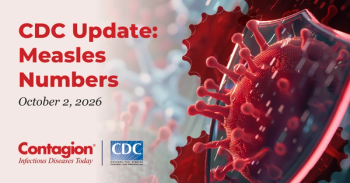
The latest CDC numbers show a 6.2% increase of measles cases from week-to-week. Last week there was a 5.4% increase in cases showing a continuing steady increase dictated by ongoing outbreaks across the US.
Recent findings on the prevalence of Chagas disease in California are in line with 2009 estimates from the Centers for Disease Control and Prevention.
Unlike with Zika virus, Chagas disease is hardly a new import from South America to the United States.
However, exactly how many people in United States are infected with the insect-borne parasitic disease remains unknown. Estimates
A new
“I am a cardiologist, and what surprised me initially, before this study began, were the number of cases I was finding with unusual cardiomyopathy,” study co-author Sheba K. Meymandi, MD, Director of the Center of Excellence for Chagas Disease, told Contagion. “When we took a closer look, it turned out that many of the pathologies we were seeing could only be explained by Chagas disease, and when we tested our cardiology patients, we found very high rates. This made me realize it was important to look for evidence of the disease in the general population as well.”
Although Dr. Meymandi admits she and her colleagues were surprised at how prevalent the disease is in this particular region of Southern California, they do note that their final estimates are in line with the CDC’s 2009 findings, which pegged Chagas prevalence at 1.31%. What is different, however, is the methods by which the numbers were drawn. Over a 6-year period, Dr. Meymandi and her team screened blood samples from 4,755 Latin American-born LA County residents for serologic evidence of Chagas. They collected demographic data and assessed the impact of established risk factors for Chagas (including gender and country of origin) on diagnosis. They found that prevalence was highest among immigrants from El Salvador (3.45%), and confirmed previous studies that determined that living in homes made from adobe and/or mud and with thatched roofs increased risk for a Chagas diagnosis. Chagas was also more common among women in the study population.
“Awareness [of Chagas] right now is very low, not only for the public but among providers,” Dr. Meymandi said. “Right now, patients who get diagnosed after giving blood are not getting enough help from doctors, who are unfamiliar with treatment guidelines, and less than 0.2% of expected cases have received treatment, [which] is unacceptable.”
In a
Brian P. Dunleavy is a medical writer and editor based in New York. His work has appeared in numerous healthcare-related publications. He is the former editor of Infectious Disease Special Edition.