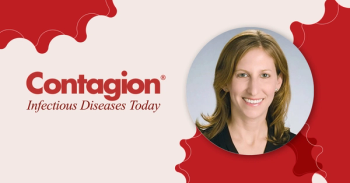
Lori Handy, MD, provides guidance in these areas, including presentation before rash onset, when patients should be considered for the inpatient setting, and what treatment looks like.

Richard Haupt, MD, MPH, explains why it’s harder to cover adults rather than children when it comes to vaccination.
Richard Haupt, MD, MPH, vice president of Medical Development at Pfizer Vaccines, explains why it’s harder to cover adults rather than children when it comes to vaccination.
Interview Transcript (modified slightly for readability):
“There are probably a lot of reasons [as to why it’s harder to cover adults rather than children when it comes to vaccination], but I’m going to give you a few of mine, what I think are some of the reasons, but this is not meant to be a completely inclusive list. I think, first of all, for many years, the focus on adults has really been much more about the treatment of diseases that adults get.
Right through medical school and training, and through clinical practice, adult health care providers have mostly been focused on ‘my patients who have a disease and I have to treat them.’ And although they have worked on some prevention interventions, they’re a little harder to employ in adult populations, and vaccines have been more limited in the adult population. And so, the idea of having vaccines that can [help] prevent disease in adults, especially elderly adults, is a really newer concept.
I’m very hopeful that all the new vaccines that are targeting adult populations become available, we will change the mindset of prevention, that vaccines can be really important as a tool. And so, I think that might happen; you know, it’s like if you have something, people will use it. And so, it may change the paradigm. But I will note an important caveat: around the world, United States as well—although it’s even more severe outside of the United States—the focus of adult health care prevention is not fully recognized by the health care community, and the importance of vaccines, especially in adults, is often deprioritized. Countries prioritize infant and child vaccination and they have not really prioritized adult vaccination and some of that is because of cost, some of that’s because of other competing priorities.
And so, there’s kind of a systemic difficulty in that space that needs to be overcome as well. Recognizing the value of an adult, and the life of that adult, and the quality of life of that adult, is something that needs to be recognized because that’s who a lot of these vaccines will address—not only extending their lives, but the quality and the functionality of their lives, as they become older. And so, we have to value that to understand why the vaccine should be used.”