
Charles M. Walworth, MD, of Labcorp discusses a new hepatitis D reflex pathway, internal data showing 8.3% of HBsAg-positive patients screened for HDV, and lessons from hepatitis C reflex testing.
Charles M. Walworth, MD, of Labcorp discusses a new hepatitis D reflex pathway, internal data showing 8.3% of HBsAg-positive patients screened for HDV, and lessons from hepatitis C reflex testing.
FDA-cleared single-step immunoblot tests built on recombinant antigens from multiple Borrelia species detected nearly twice as many early Lyme disease cases as standard 2-tier testing. Joseph J. Burrascano Jr, MD, offers insights into what the new tests mean for clinicians.
Resistance-guided testing targeting a single gene mutation could let clinicians safely reintroduce ciprofloxacin for the majority of gonorrhea cases still susceptible to it, sparing ceftriaxone as resistance climbs worldwide. Lao-Tzu Allan-Blitz, MD, MPH, offers insights into his work in this area.
Accurate, rapid diagnostics capable of distinguishing Ebola from other febrile illnesses are essential to controlling the ongoing, Bundibugyo Ebola outbreak. bioMérieux is deploying its Global Fever Special Pathogens Panel to affected regions in partnership with local governments. Chuck Cooper, MD, chief medical officer at bioMérieux, offers some insights on this testing platform and the importance of coordination with African countries to secure and deliver this technology to the hot zones and beyond.
A new multiplex blood-screening assay is streamlining transfusion safety by enabling simultaneous detection and discrimination of HIV, HBV, HCV, and hepatitis E in a single test, helping laboratories improve efficiency, reduce turnaround times, and strengthen blood supply resilience amid ongoing donation and staffing shortages. Nico Michel, PhD, of Roche Diagnostics, offers insights on this diagnostic.
Eolas Medical has an AI-powered clinical platform looking to aid health care professionals in accessing localized antimicrobial guidelines instantly, improving prescribing accuracy, reducing errors, and strengthening patient safety. CEO Declan Kelly, MBBS, provides insights on the platform and how his company is trying to address gaps in antimicrobial stewardship.
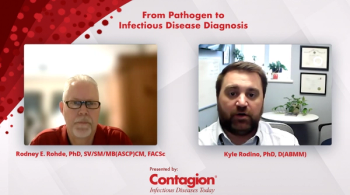
Kyle Rodino, PhD, D(ABMM), discusses the incidence rates of Lyme disease, the emergence of mosquito-borne disease, and diagnostics including the tried-and-true tests and the emergence of metagenomic next-generation sequencing (mNGS) and AI-assisted microscopy and their roles in detecting organisms and pathogens.
For those who achieve the DCLS degree, they can expand their career beyond the laboratory, bringing their expertise to the table to aid clinicians with consultation, improve patient outcomes, and increase health system efficiency. Brandy Gunsolus, DCLS, discusses the motivation that led her to become the first person in the country to achieve this newer accreditation.
In the latest From Pathogen to Infectious Disease Diagnosis podcast, Andrea Prinzi, PhD, MPH, SM(ASCP), talks about diagnostic stewardship and that when it is grounded in collaboration, education, and thoughtful test use, it can improve patient care while helping clinicians navigate increasingly complex diagnostic tools.
In our latest podcast, Jenelle Vargas Musick, DCLS, MPH, MLS(ASCP)CM, provides insights on what these professionals had to deal with during the pandemic as well as how the DCLS credential is preparing laboratory professionals to think strategically about the lab as well as earning a seat at the table for the diagnostic management team.
In our latest podcast, Elizabeth Marlowe, PhD, D(ABMM), discusses the findings of Quest Diagnostics' large US HIV testing study, which showed a significant decline in HIV drug resistance across major antiretroviral classes, reflecting the impact of modern high-barrier therapies and improved viral suppression.
In our latest podcast, first author Elizabeth Marlowe, PhD, D(ABMM), offers insights on her study looking at this ongoing issue, including the need for increased testing and getting patients into the continuum of care in a more efficient manner.
In our latest podcast, Tim Gauthier, PharmD, BCPS, BCIDP, discusses all things pathogens and antibiotics. He also details the opportunities presented for antimicrobial stewardship when it combines diagnostics and treatment duration.
In our latest From Pathogen to Infectious Disease Diagnosis podcast, bioMérieux Chief Medical Officer Chuck Cooper, MD, discusses the burden of resistance and insights on the company’s novel Vitek Compact Pro ID/AST system, which looks to identify infectious disease in a timely manner and aid clinicians in diagnosing patients, streamlining antimicrobial treatment, and avoiding severe complications such as sepsis.
MeMed CEO Eran Eden, PhD, discusses the MeMed BV test and how it can help make the distinction between the types of infections, aid in patient management, and reduce antimicrobial resistance.
This method represents a significant advancement in case management for this population. In our latest From Pathogen to Infectious Disease Diagnosis Podcast, Jose Alexander, MD, ABMM, ABAIM, FCCM, CIC, ASCP, BCMAS, provides insights on its capabilities and how it can potentially aid clinicians in reducing antimicrobial resistance.
Jose Alexander, MD, ABMM, ABAIM, FCCM, CIC, ASCP, BCMAS, and his team discovered the klebsiella pneumoniae variant, KPC-31, in a patient by sequencing the entire genome through a series of different diagnostics, which not only led to identifying the strain, but to a greater understanding of its antimicrobial susceptibility.
Last year, several cases were identified in American patients traveling to Mexico to receive cosmetic surgery. The source of transmission was discovered, and one of the investigators, Sarah Bergbower DCLS, MS, MLS (ASCP)CM, discusses her part with 1 of the cases.
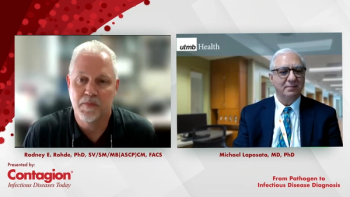
In the second episode with Michael Laposata, MD, PhD, he discusses how lab professionals can communicate with infectious disease clinicians, how AI can be used in diagnostics, and potential point-of-care diagnostic opportunities for the lab.
Here is our inaugural podcast with our host, Rodney E. Rohde, PhD, SV/SM/MB(ASCP)CM, FACSc, who interviews guests on connecting lab professionals to clinicians and the intricacies of assays, the next generation of diagnostics, and the nuances of interpreting test results.
In the last segment of the series, Jones offered his insights for when he considers discharging patients.
In this conversation, Jones discussed concerns around empirical antimicrobial treatment and opportunities to narrow down therapies.
Bruce Jones, PharmD, FIDSA, BCPS offered clinical considerations for patient dosing and clinical management strategies associated with concurrent therapy.
Bruce Jones, PharmD, FIDSA, BCPS provides commentary on treating challenging patients with comorbidities such as type 2 diabetes, higher BMI, and advanced age.
Christian Sandrock, MD, MPH, FCCP, highlights key takeaways on approaching treatment of antimicrobial resistant gram-negative infections as presented in updated IDSA guidelines and ID week 2023.
George Sakoulas, MD, provides key insights on the management of soft tissue infections including the role of single-dose agents and treating patients in an outpatient setting.
An expert in infectious diseases shares treatment considerations and clinical strategies for the management of community acquired pneumonia (CAP).
Collaboration and teamwork are essential components in addressing UTI management and antibiotic resistance, explains infectious disease clinical specialist Kim Leuthner, PharmD, FIDSA.
COVID-19 reshaped the landscape of urinary tract infections (UTIs). Explore the prevalence of resistant pathogens, the impact on infection prevention, and the changes in positive pathogens.
In this mini podcast, Kim Leuthner, PharmD, FIDSA, explores the challenges of choosing empirical therapy for complicated UTIs before culture results are available.