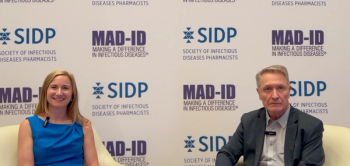
Eric Meissner, MD, PhD, discusses the takeaways of the ARTISTRY-2, phase 3 study, which compared bictegravir/emtricitabine/tenofovir alafenamide to bictegravir/lenacapavir in adults with HIV who were virologically suppressed.

Eric Meissner, MD, PhD, discusses the takeaways of the ARTISTRY-2, phase 3 study, which compared bictegravir/emtricitabine/tenofovir alafenamide to bictegravir/lenacapavir in adults with HIV who were virologically suppressed.

Phase 1 data show that the long-acting HIV-1 capsid inhibitor VH-499 is well tolerated as a single intramuscular or subcutaneous injection and demonstrates pharmacokinetics supportive of long-acting dosing intervals.

Chloe Orkin, MD, MSc, discusses the takeaways of the ARTISTRY-1 phase 3 study, including its efficacy and safety profile and the potential benefits of a single-tablet regimen in this patient population.

New in vitro data presented at CROI show that Atea Pharmaceuticals’ oral nucleotide analogue AT-587 demonstrates markedly superior potency against hepatitis E virus compared with existing off-label options, supporting plans to advance the candidate into phase 1 clinical development in 2026.

Amy Colson, MD, MPH, discusses data from the MK-8591A-052 trial that showed that switching to doravirine/islatravir maintained durable virologic suppression with efficacy and safety comparable to continuing bictegravir/emtricitabine/tenofovir alafenamide.

New 96-week subgroup data from the PASO-DOBLE study show that adults with virologically suppressed HIV who switched to dolutegravir/lamivudine experienced significantly lower rates of steatotic liver disease than those who switched to bictegravir/emtricitabine/tenofovir alafenamide, particularly among individuals with clinically meaningful weight gain.

In the phase 3 ARTISTRY-2 trial, switching people with virologically suppressed HIV from B/F/TAF to a once-daily bictegravir/lenacapavir single-tablet regimen maintained viral suppression through week 48 with comparable safety and tolerability.

In a phase 3 study of virologically suppressed adults with HIV, switching to once-daily doravirine/islatravir (DOR/ISL 100/0.25 mg) maintained high rates of viral suppression through 96 weeks, with no emergent resistance and a favorable safety profile.

Shionogi has been identifying in vitro activity using its antibiotic, cefiderocol, against Gram-negative clinical isolates such as carbapenem-resistant Enterobacterales (CRE). Christine Slover, PharmD, offers some insights on the company’s analysis.

Timothy Jenkins, MD, talks about how these important tests are being overly used for respiratory and gastrointestinal presentations and strategies his institution, Denver Health, is employing to reduce testing to save costs and still continuing to achieve optimal treatment outcomes.

Kaylee Caniff, PharmD, BCIDP, provides insights on a study looking at how urban and rural healthcare settings differ in terms of prescribing.

Nathan Shively, MD, talks about the increase of this antibiotic at his institution over the last several years for a variety of infections, particularly osteomyelitis. He also provides insights about dalbavancin's profile including its efficacy and adverse effects.

Rachel Britt, PharmD, BCIDP, provides insights on an evolving understanding of the long-time antibiotic’s limitations for these infections and provides guidance on other agents and the role of diagnostics in finding the best agents for patients.

Despite a 2018 American Academy of Pediatrics clinical update that recommends use of postexposure prophylaxis for prevention of the tick-borne disease in children younger than 8 years, Wesley Kufel, PharmD, BCPS, BCIDP, FCCP, FIDSA, points out many clinicians are unaware of this. He also discusses its efficacy at preventing the disease in this patient population.

Results from a new survey taken this past summer show immunization confidence waning among the public and some factual uncertainty around immunization. In this time of disinformation and misinformation, Ruth Lynfield, MD, discusses an approach clinicians can take in counseling parents who may have concerns about the vaccine as well as other strategies to increase immunization adherence.

In his new position, Gareth Morgan, MS, MBA, provides insights on antibiotic development strategies he would like to see during his tenure.

Jill Blumenthal, MD, MAS, offers some insights on the results from a subset of Gilead’s phase 3 PURPOSE 2 study.

At IDWeek, Jean van Wyk, MBChB, MFPM, chief medical officer at ViiV Healthcare, discussed the 96-week results from the PASO DOBLE study and the preliminary long-acting injectable PrEP results from the CLARITY study.

Ashlan Kunz Coyne, PharmD, MPH, discusses the potential of combining antibiotics with phage mixture therapy in treating these types of infections.

Jesse Clark, MD, MSc, discusses a study’s subset preliminary findings looking at this form of PrEP in this patient population.

Dumkow discusses her goals for her tenure as well as professional societies' roles in public health advocacy and AI.

At IDWeek, the company reported promising phase 1/2 trial results for its shingles vaccine candidate Z-1018, demonstrating strong immune responses and favorable tolerability.

Cornelius Clancy, MD, discusses insights from the real-world clinical analysis of the US cohort of the PROVE study.

Lori Handy, MD, MSCE, emphasized that rebuilding public trust requires continuous engagement and a collective rethinking of medical communication.

Phase 3 results for tebipenem HBr suggest an oral carbapenem could provide an effective alternative to IV therapy for multidrug-resistant UTIs.

A systematic review presented at IDWeek 2025 found that pneumococcal serotypes unique to Merck’s 21-valent conjugate vaccine, Capvaxive, are more prevalent among US adults and show higher rates of antibiotic resistance compared to those unique to PCV20.

At IDWeek 2025, Lori Handy, MD, MSCE, discussed how clinicians can strengthen vaccine communication by engaging openly and partnering with trusted community messengers.

Researchers say affordable lenacapavir could transform global HIV prevention efforts amid rising infection rates.

Invivyd’s Chief Scientific Officer Robert Allen, PhD, provides insights on the company's investigational monoclonal antibody, VYD2311, as well as its REVOLUTION clinical program.

Findings from the ongoing ROAR registry show that fecal microbiota, live-jslm (RBL), maintains strong efficacy and safety in preventing recurrent Clostridioides difficile infection (rCDI) in routine US clinical practice.