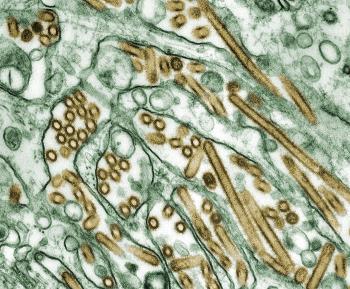
A Yakima County resident exposed to infected dairy cattle has died of avian influenza. A third human case has also been confirmed as H5N1 spreads to 33 herds in the county.
These investigators concluded Omicron XBB.1.5 the most successful COVID-19 variant of its lineage.
Unfortunately, the virus has advanced as well. COVID-19 continues to mutate, and its latest iteration, the
XBB.1.5 was first detected in October 2022, and it has since become the most prevalent variant in the United States. The latest genomic surveillance data from the US Centers for Disease Control and Prevention (CDC)
A recent
Like its Omicron predecessor BQ.1, the XBB lineage can be characterized by amino acid substitutions in its spike protein that increase viral fitness. XBB is the recombinant of 2 highly diversified BA.2 lineages, variants of concern which have since diminished to causing less than 0.1% of new US COVID-19 cases.
The investigators found the relative effective reproduction number (Re) of XBB.1.5 is 1.2 times greater than that of its paternal sublineage, XBB.1. Additionally, the dissociation constant value of XBB.1.5’s spike receptor-binding domain from the human ACE2 receptor is 4.3 times lower than that of XBB.1. “These results suggest that XBB.1.5 exhibits a remarkably strong affinity to the human ACE2 receptor,” the study authors wrote.
Their findings led the investigators to conclude that XBB.1.5 is the most successful XBB lineage. XBB.1.5 has an increased binding affinity to the ACE2 receptor “without compromising its remarkable immune resistance.”
COVID-19 vaccination remains an effective strategy, protecting against infection and severe, symptomatic disease. The newly updated
“Because the Omicron XBB.1.5 variant can spread more rapidly than previous variants and has a potential to cause the next epidemic surge, we should carefully monitor it to safeguard public health,” said study author Kei Sato, a professor in the University of Tokyo’s Division of Systems Virology and Institute of Medical Science.