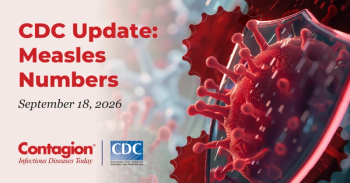
The latest CDC numbers show a 5.37% increase of measles cases from week-to-week. In Pennsylvania, the fourth measles-related death was reported in 2026. Additionally, the CDC has made a change in the way it will report deaths.
Using a model implemented in Europe in 2013 to estimate HAI prevalence by the European Centre for Disease Prevention and Control (ECDC), Nicola Thompson, PhD, CDC, and her team estimated the national burden of HAIs in US nursing homes. In their poster, Dr. Thompson and her colleagues reported preliminary data from their pilot study.
The burden of healthcare-associated infections (HAIs) on US nursing homes is currently unknown. However, researchers from the Center for Disease Control and Prevention (CDC) are working to change this.
At the Society for Healthcare Epidemiology of America (SHEA) Spring 2017 Conference, Nicola Thompson, PhD, epidemiologist, Division of Healthcare Quality Promotion, CDC, explained that the national burden for US nursing homes “has not been reported for over 20 years.” This information is imperative to determining prevention policies.
Using a model implemented in Europe in 2013 to estimate HAI prevalence by the European Centre for Disease Prevention and Control (ECDC), Dr. Thompson and her team estimated the national burden of HAIs in US nursing homes. In their poster, Dr. Thompson and her colleagues reported preliminary data from their pilot study.
At the SHEA 2017 Spring Conference, Dr. Thompson spoke with Contagion® about the ECDC’s methods in estimating that burden.
The baseline was set to include all nursing home residents (n=1,382,193), and then adjusted by resident length of stay to create two groups: residents who were there for a short stay (n=193,507) at the time of the study, and those who were there for a long stay (n=1,188,686). HAI prevalence among residents varied across the base and adjusted groups. The study used a standard of 10 days for the duration of each infection, which Dr. Thompson indicated to be one of the model’s limitations. The estimated number of HAIs per year was calculated by using the total HAI estimate per day multiplied by 365 days, divided by the mean infection duration, and was estimated to be: 2,623,401 for baseline, 614,478 for short-stay residents, and 2,039,182 for long-stay residents.
“Adjustment for resident type yielded marginally higher (~30,000) burden estimate compared to the base model,” Thompson’s team wrote. Although residents in the short-stay group made up 14% of the total study participants, they accounted for approximately 25% of the annual HAI burden in European nursing homes.
The researchers found that, “small variations in parameters have a large impact on HAI burden estimates,” and therefore, “precision from a large prevalence survey is essential.” A 1% difference in HAI prevalence changed the estimates by ~1 million HAIs yearly. Similarly, a 1-day difference in infection duration changed the estimates by ~0.5 million HAIs yearly.
Speaking to Contagion®, Dr. Thompson further discussed some of the limitations.
Dr. Thompson and her team concluded that “refinements in burden estimation approach [is] necessary for use with 2017 CDC nursing home prevalence survey.” Moving forward, the researchers will be creating a “large scale prevalence survey in US nursing homes.”