





Conference Coverage
Latest Content









Advertisement
Shorts

1:08
Why Piperacillin-Tazobactam for ESBL Still Needs Dose Optimization Data
3 days ago
by
Jason M. Pogue, PharmD, BCPS, BCIDP(+1 more)

2:06
Carbapenem-First Therapy For ESBL-Producing Organisms?
7 days ago
by
Jason M. Pogue, PharmD, BCPS, BCIDP(+1 more)
0:47
When Herd Immunity Fails: How Falling Vaccination Rates Endanger Vulnerable Children
10 days ago
by
Sharon Nachman, MD(+1 more)

0:55
Early Aggressive Supportive Care Is Key to Surviving Ebola Infection
13 days ago
by
Gavin H. Harris, MD(+1 more)

0:44
Who Keeps Food Safe?
18 days ago
by
Lynette Johnston, PhD(+1 more)
1:03
The Challenge of Capturing Complete Foodborne Numbers
19 days ago
by
Lynette Johnston, PhD(+1 more)

1:28
Can Monoclonal Antibodies Change Sudan Ebolavirus Treatment?
a month ago
by
Gavin H. Harris, MD(+1 more)

1:01
Why Are Vaccine Rates Falling in the US?
a month ago
by
Robert H. Hopkins Jr. MD(+1 more)

0:47
Physician Warns Kennedy Vaccine Task Force Is Poised to Undermine Immunization Schedule
2 months ago
by
Jason Goldman, MD, MACP(+1 more)

1:11
Executive Orders vs Evidence: Why Vaccine Policy Must Follow the Science
2 months ago
by
Jason Goldman, MD, MACP(+1 more)
Contagion: Summer 2025 Issue
View our interactive Summer 2025 issue, featuring articles on biosurveillance, aging in HIV, the NARROWS Framework for stewardship, and much more!

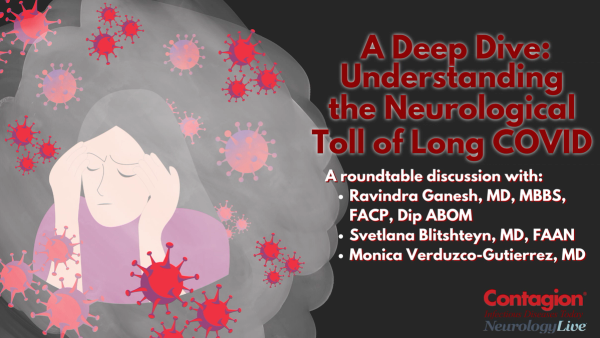
A Deep Dive: Understanding the Neurological Toll of Long COVID
Ravindra Ganesh, MD, MBBS, FACP, Dip ABOM, Svetlana Blitshteyn, MD, FAAN, and Monica Verduzco-Gutierrez, MD, discuss Long COVID's prevalence—noting that 1 in 5 Americans and 1 in 10 patients post-COVID may be affected.
Contribute to Contagion's Digital Book!
Contagion® is always looking for new contributors to the various sections of our book. Click to learn more about submitting.

Beyond the Virus: Long COVID’s Neurological Toll
There is increasing concern of Long COVID’s impact on the brain of patients previously infected with the virus. Featuring commentary from Jennifer Frontera, MD; Leigh Elkins Charvet, PhD; Neil Busis, MD; Alba Azola, MD; and Kristine Erlandson, MD.

COVID-19 Therapeutic Management and Prevention
Tina Tan, MD; Scott Roberts, MD; James Wilson, DO, FACP, FAWM, CTropMed; and Michael Curulewski, PharmD, BCPS, BCIDP, BCGP, discuss FDA-approved COVID-19 therapies, off-label treatments, and preventive modalities.







Videos






Contagion Digital Edition
Recent urinary tract infection guideline updates from multiple international
medical societies highlight evolving recommendations, including a major shift
in classification, moving from anatomy- and risk factor–based definitions
toward distinguishing localized from systemic infections.

Widespread antimicrobial use disrupts vital microbial communities that regulate Earth’s biogeochemical cycles, driving antimicrobial resistance, worsening human and environmental health, and significantly contributing to climate change.

New data from the PETERPEN trial suggest that piperacillin-tazobactam may be noninferior to meropenem for early clinical outcomes in select patients with ESBL bloodstream infections, but carbapenems remain the standard of care until final mortality results are available and fully analyzed.

In mid-May, as the world was still grappling with an unexpected hantavirus outbreak aboard a tourism vessel, news broke of an Ebola outbreak in the Ituri Province of the Democratic Republic of the Congo spanning at least 3 health zones, including Bunia, Rwampara, and Mongbwalu.

Reported cases of Legionnaires’ disease have been on the rise for the past decade, and identifying Legionella bacteria requires specialized testing in the microbiology lab. Here is a clinical overview of Legionella bacteria, including required testing, treatment, and reporting to public health officials.

A retrospective multihospital study found that severe adverse events occurred at similarly low rates with ceftriaxone and other IV cephalosporins suggesting there is no evidence to support avoiding ceftriaxone despite recent health department safety alerts.

A retrospective study of 225 patients across Cook County Department of Health clinics found that the novel 1-month 1HP regimen (isoniazid plus rifapentine) for latent TB infection had a completion rate comparable to standard longer regimens and was well tolerated, suggesting it may be a viable shorter alternative.

Here is a review of glucagon-like peptide-1 receptor agonist use in people with HIV.

Editor in chief Jason Gallagher, PharmD, FCCP, FIDP, FIDSA, BCPS, discusses the proposed OMB rule restricting federal grants for international research collaboration, and how it threatens infectious disease medicine's inherently borderless surveillance networks, publication access, and knowledge-sharing systems.

Daptomycin-resistant Enterococcus faecium bacteremia is an emerging, high-mortality challenge in transplant and other high-risk patients, requiring early recognition, aggressive source control, and reliance on limited alternatives—most notably linezolid—with combination or salvage therapies considered when options are constrained.





























































































































































All News
Advertisement
Advertisement

Demonstrating a diagnostic test works is no longer enough. Clinicians and laboratories also need evidence on how to adopt it in everyday practice. Andrea Prinzi, PhD, MPH, SM(ASCP), explains how implementation science can help infectious disease and clinical microbiology teams turn evidence into routine care.

Kenya reported its first imported Bundibugyo Ebola death as the Democratic Republic of Congo (DRC) outbreak surpassed 8,600 confirmed cases and 4,148 deaths, with 896 patients hospitalized in isolation. Here is a report on the latest numbers as well as vaccine and therapeutic study updates.
With US measles cases nearing 3,900 this year and Pennsylvania reporting its fifth measles-related death, here is a review of how the virus spreads, how it is prevented and managed, and what severe disease looks like.

Vaxcyte's 31-valent pneumococcal conjugate vaccine candidate met every prespecified primary immunogenicity and safety endpoint against PCV20 and PCV21 in the OPUS-1 trial of 4,047 US adults.

Long-acting cabotegravir plus rilpivirine (Cabenuva) achieved superior viral suppression vs daily oral antiretroviral therapy at 6months in treatment-experienced people with HIV and detectable viremia in the phase 3b CROWN trial.
FDA-cleared single-step immunoblot tests built on recombinant antigens from multiple Borrelia species detected nearly twice as many early Lyme disease cases as standard 2-tier testing. Joseph J. Burrascano Jr, MD, offers insights into what the new tests mean for clinicians.

Irkutsk anti-plague institute death prompts quarantines and conflicting official accounts.
A laboratory technician at a Siberian anti-plague institute has died of pneumonia of unknown cause, prompting quarantines and contact monitoring while Russian officials stop short of confirming plague.
Recent urinary tract infection guideline updates from multiple international medical societies highlight evolving recommendations, including a major shift in classification, moving from anatomy- and risk factor–based definitions toward distinguishing localized from systemic infections.

A study finding clesrovimab comparable to palivizumab in protecting at-risk infants in their first RSV season was extended to demonstrate clesrovimab effective and well-tolerated when administered in their second season.
Advertisement
The latest CDC numbers show a 6.2% increase of measles cases from week-to-week. Last week there was a 5.4% increase in cases showing a continuing steady increase dictated by ongoing outbreaks across the US.

Lori Handy, MD, provides guidance in these areas, including presentation before rash onset, when patients should be considered for the inpatient setting, and what treatment looks like.

IDSA/ESCMID panel member Henry Chambers, MD, explains why the new S aureus bacteremia guidance replaces the complicated vs uncomplicated label with risk stratification, and how the statements are akin to the stages of cancer in guiding treatment decisions associated with this bacteremia.

Jason Pogue, PharmD, BCPS, BCIDP, contextualizes preliminary data looking at this trial and other extended-spectrum beta-lactamase (ESBL) studies, which reopens the debate around carbapenem-sparing treatment options.

Following World Rabies Day and a CDC health advisory on a 17% rise in exposure-related calls, Rodney E. Rohde, PhD, explains what the increase means, what people should do when they have an animal bite or scratch, and how clinicians should assess risk and administer post-exposure prophylaxis (PEP).
Advertisement

Advertisement