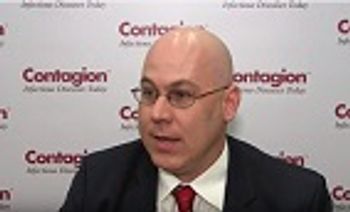
Marion A. Kainer, MD, MPH, FRACP, FSHEA, director, Healthcare Associated Infections and Antimicrobial Resistance Program, Tennessee Department of Health, outlines currently available strategies to avoid antimicrobial resistance.


Marion A. Kainer, MD, MPH, FRACP, FSHEA, director, Healthcare Associated Infections and Antimicrobial Resistance Program, Tennessee Department of Health, outlines currently available strategies to avoid antimicrobial resistance.

Marion A. Kainer, MD, MPH, FRACP, FSHEA, provides key points to help healthcare providers prevent healthcare associated infections.

A norovirus vaccine developed by Takeda is the first and only one to be tested in human trials.

The belief that patients may face increased risks of complications following reduced antibiotic use after experiencing self-limiting respiratory tract infections (RTIs) may not be well-founded.

Gonzalo Bearman, MD, MPH, hospital epidemiologist, Virginia Commonwealth University, describes the risks of animal to human infection transmission in healthcare settings.

The Hawaii State Department has confirmed an open investigation of the hepatitis A infection in Oahu, Hawaii.

Prof. Andrea Endimiani, MD, PhD, from the Institute of Infectious Diseases at the University of Bern, Switzerland, discusses how practitioners should test for colistin-resistant pathogens.

The number of confirmed cases in the outbreak has been attributed to the reluctance of some to be vaccinated.

Since May, there have been nine confirmed cases, with one fatality, in Los Angeles, Long Beach, and Orange counties. According to the California Department of Public Health (CDPH), most of those infected have been gay and/or bisexual men.

In a recent clinical alert, the Centers for Disease Control and Prevention (CDC) warned US healthcare facilities about Candida auris, an emerging multidrug-resistant (MDR) yeast that is causing severe, and sometimes fatal, healthcare-associated infections.

Jason C. Gallagher, PharmD, FCCP, FIDSA, BCPS, President, Society of Infectious Diseases Pharmacists, shares his thoughts on the “elephant in the room” with regards to antimicrobial stewardship.

One month before the summer Olympics are set to be begin in Rio de Janeiro, Brazil amid the threat of the Zika virus, another health threat has been identified in the city.

Kirk Hevener, PharmD, PhD, explains the importance of narrow-spectrum antibacterial targets.

Romney Humphries, PhD, D(ABMM), discusses new technologies to detect antimicrobial susceptibility and resistance that are currently under production.

Andrew Chasteen from Accelerate Diagnostics, Inc, explains Morphokinetic Cellular Analysis (MCA) and how it differs from other analyses.

Prof. Andrea Endimiani, MD, PhD, from the Institute of Infectious Diseases at the University of Bern, Switzerland, explains which pathogens are most affected by the colistin resistant mcr-1 gene.

John Mohr, PharmD, president and founder of Medical Affairs Strategic Solutions, LLC, explains the current state of the antimicrobial pipeline.

Monica Mahoney, PharmD, BCPS-AQ ID, clinical pharmacy coordinator of infectious diseases at Beth Israel Deaconess Medical Center, explains the antimicrobial considerations that are specific to the solid organ transplant population.

Emily Heil, PharmD, BCPS-AQ ID, from the University of Maryland School of Pharmacy, discusses the concerns of antibiotic use in agriculture.

Jason C. Gallagher, PharmD, president, Society of Infectious Diseases Pharmacists, explains if we know how the case of mcr-1 E. coli superbug was contracted.

New research suggests that modernized phages therapy may be useful in extending the lifespan of currently available antibiotics and reducing the incidence of antibiotic-resistant infections.

US travelers concerned about contracting cholera during overseas journeys to areas where the disease remains a threat may now have options as they seek to reduce their risk.

Researchers at McGill University in Montreal revealed that the gene editing tool known as CRISPR/Cas9, which had previously been shown to hold some promise in removing HIV-infected cells from the human genome, may in fact be a “double-edged sword.”

Marion A. Kainer, MD, MPH, FRACP, FSHEA, Director of Healthcare Associated Infection and Antimicrobial Resistance Program, Tennessee Department of Health, discusses some of the key points to aid in the fight against healthcare associated infections, nationwide.

Jason C. Gallagher, PharmD, President, Society of Infectious Diseases Pharmacists describes the recent case of an antibiotic resistant “superbug” in Pennsylvania.